








-180x100.png)

08/12/2025
Feed accounts for about 70% of farm costs. However, this does not mean that all of it is absorbed by the birds. Unfortunately, a large part of these funds is lost due to old feeders and lack of control. Modern equipment is not just a pretty picture and a high price tag, it is also functionality and rationality, where every gram of feed is controlled and livestock growth is predictable.
The VADA company, which has been engaged in the turnkey construction of poultry houses for many years and implements automatic systems for poultry farms throughout Ukraine, knows well that savings do not begin with reducing feeding rates, but with the right equipment for broilers.
Why do farmers lose feed?
Technical errors often lead to a significant amount of feed being lost. Based on the practical experience of VADA engineers, the main reasons are as follows:
- Choosing feeders that are not suitable for the age of the birds and the stocking density. The fact is that in the first days of life, chicks need low feeders from which they can easily eat. And at the end, systems with uniform access for adult birds. It is precisely the mismatch between the equipment and the age of the birds that leads to spillage or uneven eating by all chickens.
- Incorrect installation and height. If the feeder is placed too low, the birds will throw the feed out. If it is too high, some of the broilers will not be able to reach the feed. In both cases, this results in direct costs.
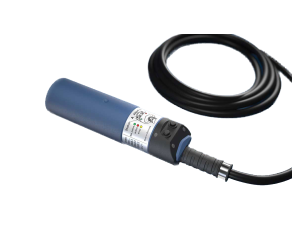
- Lack of feed level sensors. Sensors signal the need to refill the broiler's feed and start this process automatically. Without them, this happens chaotically, and the birds do not always have access to food.
- This leads to competition, fighting and stress.
- An incorrect microclimate also plays an important role in feeding. If the birds are comfortable in the poultry house, they have a good appetite and gain weight steadily.
All these factors are controlled by technologically advanced feeders and sensors.
Modern feeders for broilers reduce costs
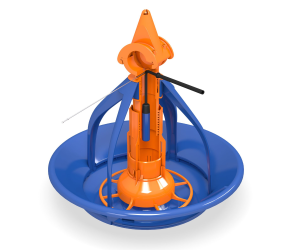
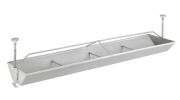
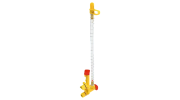
Properly selected feeders are a guarantee of success. These models are designed so that the feed does not spill, is not accessible to pests, and is not lost during feeding. There are several types.
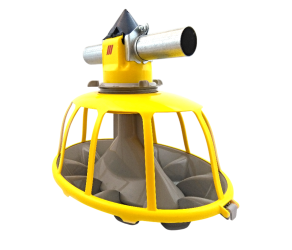
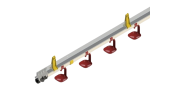
Automatic feeders for broilers ensure even distribution of feed, so the birds are always full. They also reduce the workload on staff.
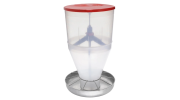
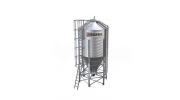
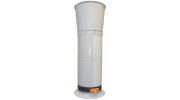
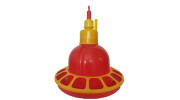
Bulk feeders for broilers are spacious, which means they do not need to be refilled as often, and they protect the feed from rodents, moisture and spillage. They are often installed on medium and large farms.
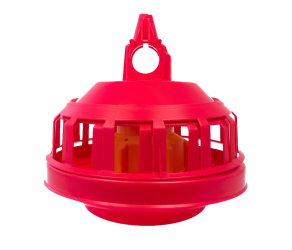
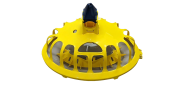
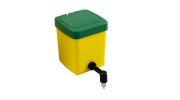
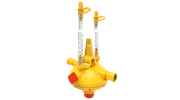
There are separate feeders for chicks, which are designed so that the birds are full and the feed is only in the feeder. An even start is very important for young birds.
But even the best feeder will be ineffective without a control system. This is where sensors come into play.
Feed-saving sensors
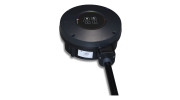
They are also called the ‘eyes and ears’ of the farm. Because they know everything about every parameter. Feed level sensors measure food residues in the bunker or on the line and automatically start feeding, so there are no ‘hungry’ breaks for the birds. Microclimate sensors measure temperature, humidity and carbon dioxide. And the right microclimate means a good appetite, better feed conversion and uniform livestock growth. Every farmer's dream!
Tension sensors are attached to bunkers or feeding lines and measure actual feed consumption. What does this mean? It means precise control, hourly consumption analysis, and instant alerts in case of deviations. This technology helps to respond to problems as they arise, rather than after the fact.
"We see the greatest feed losses on farms with old feeders without automation. In such farms, it is difficult to implement any modern technologies due to outdated broiler equipment. Sensors for broilers and feeding lines help control feed delivery to the second and to the gram. This provides savings of up to 15% without loss of growth," says Oleksiy Yurchenko, an engineer at VADA.
And what will be the result on a farm with good new equipment but without sensors? Feeders are only half of the system. According to the VADA specialist, if the sensors do not show the real parameters in the poultry house, then no feeder, no matter how cool it is, will work effectively. Because savings always start with control.
In summary, let's look at how the combination of feeders and sensors provides maximum benefit. With this combination, the poultry house gets:
- stable access to feed for the birds,
- minimal losses at the edges of the plate,
- predictable feed consumption,
- elimination of the human factor and automatic feeding,
- minimal competition for food among broilers,
- uniform average weight across the farm
- and good feed conversion.
Here, the equipment does not just work, it controls all processes independently.
VADA has extensive experience in the implementation and installation of feeding equipment in poultry houses. These are certified, time-tested, high-quality feeders for any type and age of poultry. The company provides a full cycle of solutions: from equipment selection to automation and monitoring. We select feeders according to the scale and technology of your farm, install them, set up sensors for poultry farming, automate the microclimate and watering systems, and also design and equip a turnkey poultry house. After completion of the work, our cooperation continues through service and technical maintenance. The advantage of this approach is that all elements work as a single organism — without losses, failures, or feed overspending.
In addition to a wide selection of feeders, the VADA online store offers sensors for livestock and poultry farming, as well as any other farm equipment. With us, your farm will be modern and efficient!
08/12/2025