






































-180x100.png)





04/02/2026
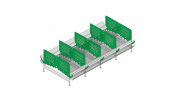
A hen's nest is where eggs are laid. The productivity of laying hens, their health and the profitability of the farm depend on how convenient and comfortable it is. Modern automatic nests are specialised nesting systems with mechanised or automated egg collection, which ensure gentle transport, minimal contact with staff and the ability to control processes in real time. They are practically indispensable for large poultry farms, where there are thousands and tens of thousands of birds, and every minute of work and every whole egg are expensive.
Over the years, VADA has gained extensive experience in industrial poultry farming and has a thorough understanding of the technology involved in raising different types of poultry. This helps us to offer our customers not just solutions, but professional engineering solutions that really work on domestic farms. The engineers and installation team have many different projects under their belts, which are designed from scratch, built and filled with all the necessary equipment, as well as modernised with state-of-the-art systems. "Installing equipment on a farm is not a problem. The main thing is to integrate it with what is already working so that everything works together to produce results. And if we talk specifically about the nest, it is not a separate unit, but part of a technological chain that must be coordinated with ventilation, lighting, and egg logistics," the company emphasises.
Problems of poultry farmers without automatic nests
Many poultry farms continue to operate as before, considering automatic nests to be a luxury. Production seems to be there, and profits are even being made. However, it is in the nesting area that losses, invisible at first glance, most often occur, but which eat into income every day. Manual egg collection, constant contact between staff and birds, and the lack of automatic accounting create a chain of problems that affect productivity, flock health, and overall farm costs. Let's take a closer look at them.
- Injuries to birds during manual collection due to the fact that workers are forced to walk among the birds. Chickens get scared, push each other, bump into cages, and injure themselves in the process.
- Damage and loss of eggs. Since they come into contact with the floor and litter, some of them get dirty and damaged. As a result, the loss of marketable eggs increases and the proportion of waste increases.
- High labour intensity due to the fact that manual collection requires the involvement of many people. This leads to an increase in labour costs.
- Insufficient control over the egg production of hens due to the lack of automatic recording. In this case, the farmer receives information late. It is then difficult to respond to processes associated with a drop in productivity.
Advantages of automatic nests
- Fewer injuries to birds and more marketable eggs. This is facilitated by the soft bottom of the nest, the correct slope and belt conveyors that gently move the eggs. The birds have less contact with staff.
- Saves time and resources. Minimal manual intervention. One operator can monitor many hens.
- Automatic control of egg laying in the poultry house. The systems are capable of recording the number of eggs, peak egg laying times, and reporting health problems in the flock.
- Increased poultry house productivity. When birds are comfortable and calm, they produce stable and high results.
- Integration with other systems: nests work closely with lighting, ventilation, feeding and monitoring systems.
‘The correct placement and integration of nests solves many poultry house problems before the egg even appears on the surface,’ concludes the VADA engineer.
Effective use of automatic nests
Poultry house automation integrates feeding, lighting and egg collection into a single controlled system.
Nest placement
If nests are not installed correctly, the hen will avoid them and eggs will increasingly be found on the floor. Experts recommend installing nests in a quiet, darkened area without draughts so that the birds feel comfortable in them.
Maintenance and control
If worn parts in the nest are not detected in time, the likelihood of broken eggs increases. To avoid this, it is necessary to regularly clean and inspect the belts and mechanisms.
Minimising stress in birds
A laying hen may avoid the nest due to sudden changes in lighting or noise. As a result, egg production decreases. The conclusion here is simple: pay attention to lighting so that it is optimal for the birds, and create a stable microclimate.
Manual or automatic: which is more productive?
Comparison of collection methods
|
|---|
Who are automatic nests suitable for?
Industrial poultry farms that work with large quantities of eggs on a daily basis, where even 1-2% losses translate into significant financial losses.
Automatic nests allow you to standardise the collection process, minimise the human factor and ensure consistent product quality across all lines. The result is predictable productivity, consistent egg quality and a controlled technological process that meets market requirements.
Farms with several thousand birds: manual collection loses its efficiency as the farm expands in size. It becomes increasingly difficult to control quality.
Installing automatic nests at this stage helps to reduce labour costs.
Farms planning to scale up: investing in automation at the start is cheaper than completely rebuilding the poultry house in the future. Such farms immediately build technology for future volumes, rather than current needs.
Enterprises with staff shortages: staff shortages are a reality today. With automatic nests, this problem disappears on its own.
‘The best time for automation is before the shortage of people begins to slow down the development of the farm,’ says a VADA engineer.
Therefore, automatic nests for chickens are not just another whim of technologists, but a tool that really increases production efficiency: it preserves the health of poultry, reduces injuries and labour costs, and ensures stable productivity and control over egg-laying processes.
VADA engineers know how to design and select poultry equipment that will work well on your farm, install it, train your staff to use it, and assist with maintenance. Everything in one place — order a turnkey service and avoid headaches.
Automation starts with the nest – and that's the first step towards a modern, controlled and profitable poultry house.
04/02/2026